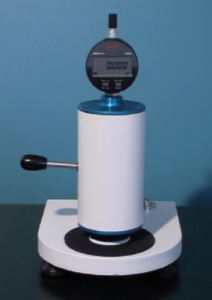
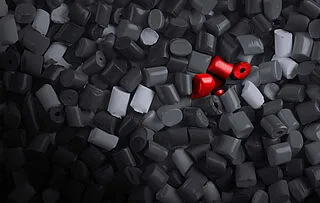
Manual notching plane
Used exclusively to notch plastic specimens according to standard ASTM D256, ASTM D6110, ISO 179, ISO 180, ISO 8256, ASTM D1822 and BS 7413:2002.
Key features:
- The table-top device can be operated manually with one hand
- With each turn of the crank, the notching plane causes a stroke of the blade, alternating with a sideways movement of the specimen magazine.
- The extremely durable notching blade has three cutting edges and can be changed out quickly
Advantages:
- Ergonomic operation
- Interchangeable specimen magazine
- Automated stop function when the remaining width is reached
Manual cutting press with bent lever
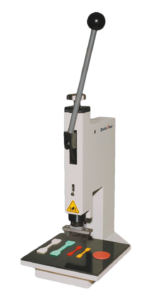
- Used to produce specimens from rubber, elastomers and flexible foam materials with a maximum hardness of 60 Shore (to ISO 868) and a material thickness of 8 mm on plastic film and paper.
- Specimen shapes: rectangular specimens, dumbbell specimens, round specimens and special-shape specimens.
Key features:
- Enables precise, low effort and comfortable completion of tasks
- 30% higher cutting force compared to conventional presses
- Can be set up on any workbench or laboratory table, or mounted at optimal height on a sturdy wall
- Easy, quick, and accurate height adjustment of the compression die to accommodate the varying heights of different cutting blades
Advantages:
- Standard-compliant machining of specimens
- Simple operation
- Long tool service life
Manual cutting press with eccentric lever
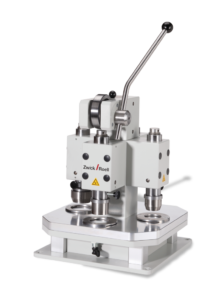
- Used to produce specimens from rubber, elastomers and flexible foam materials with a maximum hardness of 60 Shore (to ISO 868) and a material thickness of 8 mm on plastic film and paper.
- Specimen shapes: rectangular specimens, dumbbell specimens, round specimens and special-shape specimens.
Key features:
- Designed to hold up to four cutting devices simultaneously
- Rectangular specimens up to 160 x 30 mm and 75 x 75 mm square specimens can also be machined (option)
Advantages:
- Standard-compliant machining of specimens
- Simple operation
- Long tool service life
Pneumatic cutting press
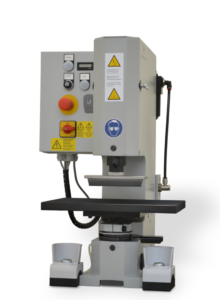
- Used to produce specimens from rubber, elastomers and flexible foam materials with a maximum hardness of 60 Shore (to ISO 868) and a material thickness of 8 mm on plastic film and paper.
- Specimen shapes: rectangular specimens, dumbbell specimens, round specimens and special-shape specimens.
Key features:
- Allows for higher cutting forces
- The standard specification includes two-handed operation, with a safety interlock and retainers for the cutting blades
Advantages:
- Standard-compliant machining of specimens
- Simple operation
- Long tool service life
Automatic notch cutting machine
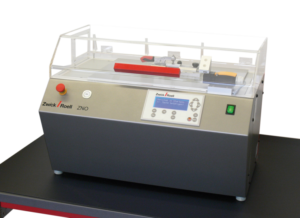
Used to notch plastic specimens according to standard ASTM D256, ASTM D6110, ISO 179, ISO 180 and ISO 8256, ASTM D1822 (Charpy and Izod tests)
Key features:
- A v-shaped notch is machined on one side of the specimens using a milling head
- Several test specimens are clamped into one stack and notched at the same time
- We offer an optional measuring device to test the notch depth
- Different cutters, which can be easily exchanged, are available for different materials and notch radii.
Advantages:
- Stepless adjustment of cutting speed and feed rate
- Manual notch-depth setting via fine-pitch screw-adjuster
- Specimens are easily and securely fastened in the fast acting gripping device
Film strip cutter
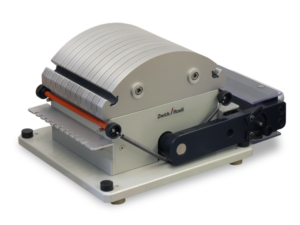
With the ZwickRoell film strip cutter, up to 10 parallel specimen strips are produced in a single operation from films approximately DIN A 4 in size. These specimen strips can be used for standard-compliant performance of tensile strength tests on film.
Key features:
- The adjustable double-cutting blade holder enables operation both towards and away from the operator.
- The film is pulled over the curved clamping surface avoiding any wrinkles and fastened in the clamping groove on the front and back of the device by means of the rubberized clamping strip. The cutting operation is performed by simply moving the handle on the swivel frame in the desired direction.
- The position of the cutting blades in the swivel frame ensures safe and injury-free operation of the film strip cutter.
Automated specimen preparation system
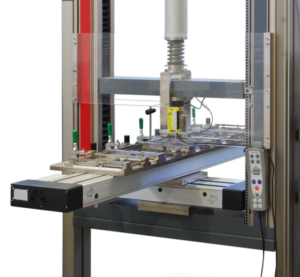
A 10kN materials testing machine with motorized X-Y table is used with the automatic specimen-blanking machine.
Key features:
- The operator is protected by a safety device around the blanking tool and the moving crosshead.
- Specimen sheets are placed on the motor-driven X-Y table and secured with quick-acting clamps. The system is started and specimens are punched out of the sheets in different positions according to the test program or blanking program. The blanking tool itself is fitted with an automatic cup extractor.
- The specimen shape depends on the blanking tool installed. Various blanking tools can be used, entirely according to your requirements. The blanking tool is changed manually.

Paper strip cutter
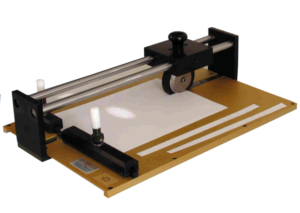
Each of the five available models for strip widths 12.7 / 15 / 15 and 25 / 25.4 / 50 mm are suitable for paper with a mass per unit area of 30 g/m² to 350 g/m². The are supplied with a holding-down clamp and a set of spare cutting wheels.
Circular cutter
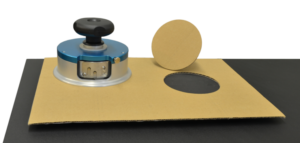
Circular cutters are used to produce round specimens for flat crush tests (FCT) to ISO 3035 and EN 23035 on paper, cardboard and corrugated board. With a quarter turn of the handle, the four blades cut out a circular specimen with a surface area of 50 or 100 cm2, for specimen thicknesses of max. 5 mm. Both models are supplied with a cutting pad and 10 spare blades.
Fluter
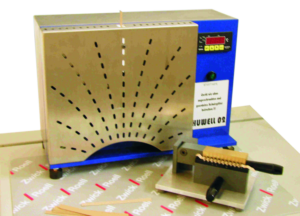 The luter is used to machine CMT specimens to ISO 7263, TAPPI T809, and SCAN P27.
Automatic edge crush test (ECT) - specimen saw
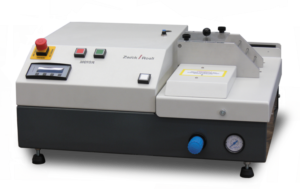
The ECT specimen saw with automatic cutting guide is used to machine standard-compliant specimens for edge crush tests (ECT) on corrugated board according to DIN EN ISO 3037. They must be conditioned according to standard ISO 187. The automatic carriage advance enables exact reproducibility for a wide range of specimens, as all are sawed under the same conditions.
Advantages:
- Specimens are machined with parallelism better than 0.05 mm.
- With optimum adjustment (rpm and carriage advance), ECT values 15–20% above the standard value can be obtained.
- The rotational speed is steplessly adjustable in a range of 5000 to 24000 rpm.
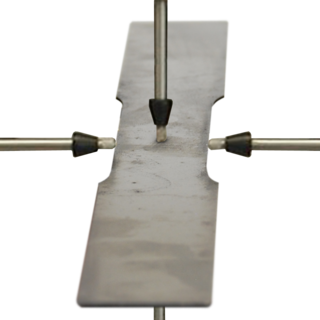
Cross-section measuring devices for metals and plastics
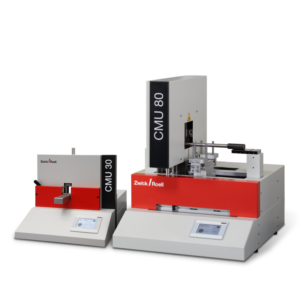
Cross-section measurement of dimensionally stable specimens made of metal, plastic, composite and other materials.
Thickness measuring device for corrugated board
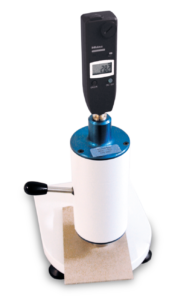
Thickness measuring device for corrugated board to FEFCO test method No. 3/85; to ISO 3034; for corrugated board thickness up to 25 mm
Thickness measuring device for paper