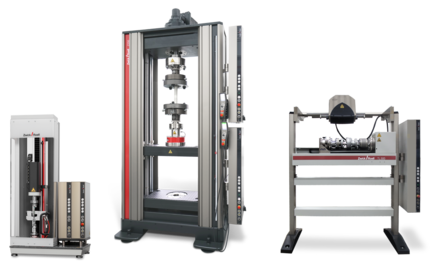
เครื่องทดสอบแรงบิด Torsion Testing Machine

ด้วย Amsler HDT/Vicat Allround 6-300 ทำให้ ZwickRoell นำเสนอเครื่องมือแบบมอเตอร์ที่มีลำดับการทดสอบอัตโนมัติเต็มรูปแบบเพื่อการทดสอบที่สะดวกและง่ายดายในด้านการวิจัยและพัฒนา การตรวจสอบสินค้าขาเข้า การตรวจสอบการผลิต และเพื่อวัตถุประสงค์ในการสอนและการฝึกอบรม การทดสอบครอบคลุมทุกมาตรฐาน ISO 75, ISO 306, ASTM D1215 และ ASTM D648

Our Torsion Testing Machine Product

Industries

  • Plastics
  • Metals
  • Automotive
  • medical industry

Test load

  • 2.5 – 250 kN
  • 2 – 2,000 Nm

Type of test

  • Uniaxial or biaxial torsion test

What is torsion testing?

The torsion test is a mechanical test method used to examine the deformation of a specimen through a twisting/rotating motion.

Torsion, in its simplest form, is the action of twisting. Many everyday materials, components, component assemblies, and end-user products used in various industries are designed with the primary purpose of supporting this direction of movement. Products include screws, springs, syringe components, wire, tubing, and many more.

In the world of materials testing, we use torsion testers to simulate this twisting motion and help manufacturers determine important material properties, including:

  • Maximum torque
    The maximum torque (twisting force) value that can be applied before specimen failure. Once the maximum torque is found on a screw or bolt, for example, a safety factor can be calculated and built into the torque strength specifications of that product.
  • Torsional strength
    The ultimate strength of a specimen, and the maximum torsional stress that a specimen that is subjected to a torsional load can withstand before failure.
  • Torsional shear stress
    Shear stress that acts on a transverse cross section of the specimen due to torsional motion. Torsional loading creates uneven stress distribution over the cross section of the specimen, ranging from zero in the center to maximum torsional shear stress at the edge of the specimen.
  • Modulus of elasticity in shear
    Elastic shear stiffness defined as the ratio of shear stress to shear strain. When comparing identical products, the higher the modulus of elasticity of the material, the greater the stiffness. The greater the stiffness or rigidity of a structure, the more force is required to cause deformation.
  • Breaking angle of the specimen
    The breaking angle provides a measure of the ductility of a material when undergoing a torsional moment. According to ASTM F543-13, for example, a medical bone screw with a greater breaking angle may provide an earlier tactile warning to the surgeon that it is reaching its maximum torsional strength.

Depending on your torsion test application, torsion testing machines can be set up to run on material specimens up to the point of failure or based on a defined torque and duration. They can also be run on finished product assemblies, such as pharmaceutical pen injectors or screw caps to determine proper function of the device.

Advantages and features

Torsion drives

Torsion drives

  • Because of their modular design, torsion drives can be retrofitted to existing testing machines at any time
  • The modular design allows for the use of a number of components from the ZwickRoell standard products portfolio, including specimen grips, test tools, temperature chambers and more
  • Operation using our testXpert testing software on a standard PC (no additional interface card required)
  • High-resolution rotation angle and travel measurement for maximum repeat accuracy
  • Easy handling and user-friendly operation for maximum flexibility
  • Synchronization of the two test axes
zwickiLine materials testing machine with torsion drive
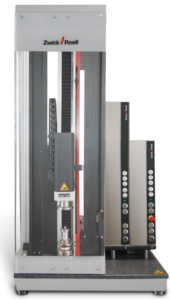
zwickiLine materials testing machine with torsion drive
  • Uniaxial and biaxial tests (tensile or compression combined with torsion)
  • Seamless integration with many of our standard components (specimen grips, test tools, temperature chambers and more)
  • Operation using our testXpert testing software on a standard PC (no additional interface card required)
  • High-resolution rotation angle and travel measurement for maximum repeat accuracy
  • Easy handling and user-friendly operation for maximum flexibility
  • Synchronization of the two test axes
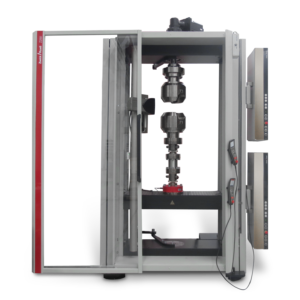
AllroundLine materials testing machine with torsion drive

AllroundLine materials testing machine with torsion drive

  • Available as table-top or floor-standing machine
  • Axial tests and biaxial tests (tensile or compression combined with torsion)
  • Drive mounted on upper crosshead or moving crosshead
  • Torque transducer combined with load cell (if required)
  • Seamless integration with many of our standard components (specimen grips, test tools, temperature chambers and more)
  • Operation using our testXpert testing software on a standard PC (no additional interface card required)
  • High-resolution rotation angle and travel measurement for maximum repeat accuracy
  • Easy handling and user-friendly operation for maximum flexibility
  • Synchronization of the two test axes

testXpert testing software

ZwickRoell torsion test machines for axial tests and axial torsion tests seamlessly interact with our test tools and accessories, our testXpert testing software and our testControl measurement and control electronics.

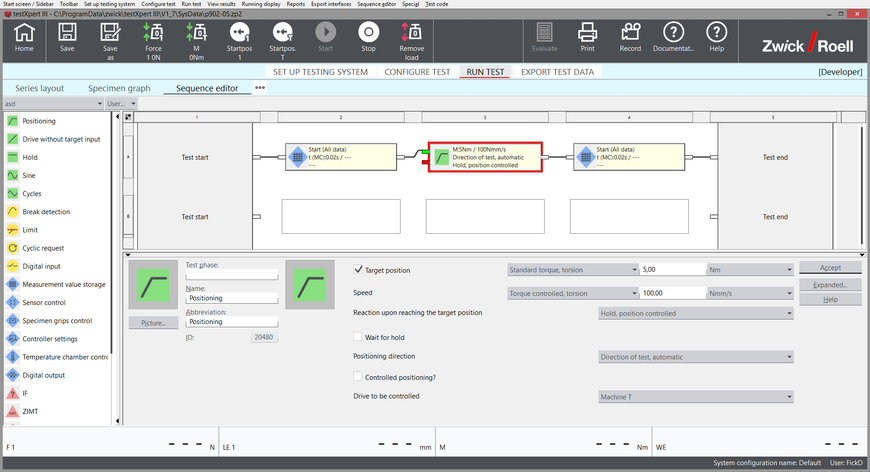
testXpert III features a standard-compliant master test program, pre-configured for multiple test axes and includes our graphical sequence editor for freely programmable test sequences using simple function blocks.

How do torsion testers work?

Materials testing machines are equipped with a torsion drive, which operates and controls the torque and speed of the rotating motion.Depending on your testing needs, you can use these torsion tests to perform uniaxial and multi-axis load tests (tensile or compression combined with torsion).

To run a test, your specimen is placed in the grips of the torsion testing machine and one end of the specimen is twisted around the long axis for a specified number of turns, a specified amount of time, or until failure, depending on your application and test purpose.

The torque or twisting force applied to the specimen induces torsion on the specimen, causing a distribution of stress over the specimen’s cross-sectional area (shear stress). This differs from tensile or compressive loads, which produce uniform stress over the specimen’s cross section.

Common standards for torsion testing

  • ASTM A938-18 – Standard Test Method for Torsion Testing of Wire
    Wire is twisted at a defined speed and the number of total turns to fracture is determined. If the number of turns is satisfactory, the specimen is considered to have passed the test.
  • ASTM F543 – Standard Specification and Test Methods for Metallic Medical Bone Screws
    This standard applies to metallic bone screws that are implanted into bone. The torsional strength is tested to ensure that the screw does not break during insertion or removal. Properties measured include the torsional yield strength, maximum torque, and the breaking angle under standard conditions.
  • ISO 7800 – Metallic Materials – Wire – Simple Torsion Test
    Used to determine the ability of metallic wire with a diameter or characteristic dimension from 0.1 mm to 14 mm to undergo plastic deformation during simple torsion in one direction. The test is run until the specimen breaks or until a specified number of turns is reached.
  • ISO 7206-8 – Implants for Surgery – Partial and Total Hip Joint Prostheses – Part 8:Endurance performance of stemmed femoral components with application of torsion
    The stemmed femoral components are tested in their ready-for-use condition and must not break during the specified number of cycles and test load specified in the standard.

Technical overview

    Etiam magna arcu, ullamcorper ut pulvinar et, ornare sit amet ligula. Aliquam vitae bibendum lorem. Cras id dui lectus. Pellentesque nec felis tristique urna lacinia sollicitudin ac ac ex. Maecenas mattis faucibus condimentum. Curabitur imperdiet felis at est posuere bibendum. Sed quis nulla tellus.

    ADDRESS

    178/57 พุทธมณฑลสาย2 ซอย33 แขวงศาลาธรรมสพน์ เขตทวีวัฒนา กรุงเทพฯ 10170 ประเทศไทย

    PHONE

    +66 (0) 2 024 8471
    +66 (0) 81 420 1638

    EMAIL

    Sales@scsinstruments.co.th
    Service@scsinstruments.co.th

    Cart